
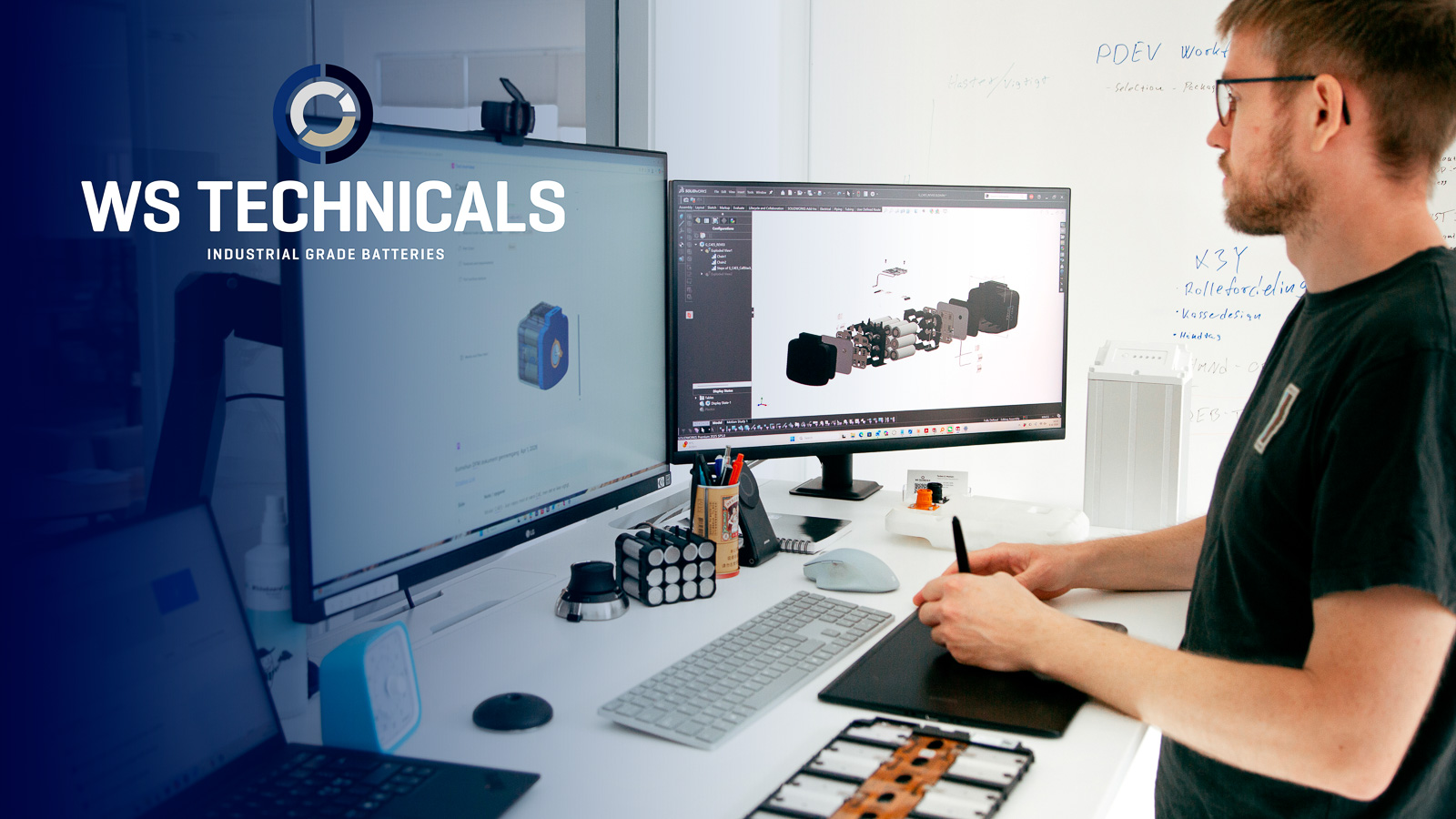
In custom battery design, some challenges can be solved by experience, calculation, and established methods. Others require something more difficult to define: the ability to look at a problem from several angles at once, question the obvious solution, and see a path forward where none seems immediately available.
For Søren Nørby, Senior Project Engineer at WS Technicals, this is a central part of the job.
“I’m not very good at just being told that now we need to make a box,” he says. “I always start the process by asking: Have we thought this through? What about this? And what about that?”
It’s a simple way of describing a quite complex role. Søren works with concept development, industrialized design, and major projects. But his contribution isn’t only about drawing a battery pack or solving mechanical tasks in isolation. It’s especially about unfolding the problem behind the task.
When a project involves something new, something untested, or something that doesn’t immediately fit into an existing method, Søren is often one of the people brought into the process. Not necessarily because he knows the answer from the beginning, but because he knows how to start looking for it.
“If there’s something we haven’t done before, I’m often put on it,” he explains. “Because one thing is finding a way to solve it. Another thing is getting it executed. Ideas aren’t enough. They have to be turned into something in practice.”
“Ideas aren’t enough. They have to be turned into something in practice.”
That particular sentence says a lot about the kind of creativity that matters in engineering, because creativity is so much more than merely ‘decoration’. Creativity can be a practical discipline where the ability to move from an unclear challenge to a physical, functional, and producible solution all merges together.
Industrial design as a way of thinking
Søren has a MSc in Engineering (Architecture and design) – specialized in industrial design, but he is careful not to reduce his background to aesthetics. For him, industrial design is first and foremost a method. It’s a way of approaching problems with both technical understanding and a broader sense of context.
“I can’t help but having the full picture in mind when I start working on something,” he says. “If I can’t understand it right away, then I usually know what I need to do in order to understand it.”
“If I can’t understand it right away, then I usually know what I need to do in order to understand it.”
That full picture can include form factor, cell layout, mechanical integration, assembly, tolerances, service access, production methods, sourcing, and the physical reality of the customer’s machine. A battery pack isn’t just a collection of cells and components. It’s something that has to fit into a real application, survive real use, and make sense for the people who will build, install, and maintain it.
This is where Søren’s way of thinking becomes particularly valuable.

Some people look at a task and primarily see the main outline. Søren sees the outline, but he also sees the hidden details that may later determine whether the solution works. He describes it through a simple metaphor: someone may ask for a cardboard box, but Søren’s brain is wired to immediately start thinking about what’s actually going to be inside the box? What material is the box made from? What color should it be and how will the graphics be applied? Will the bottom fall out if the box if it’s filled with stones?
“There are people who think in the overall lines,” he says. “I can do that too, but that isn’t where I’m best. It’s better to unfold the whole thing.”
When practical details become critical
In battery design, that ability to unfold the whole thing matters. A mechanical solution can look fine in principle and still become difficult in practice. A lid has to close. Screws have to be accessible. A housing has to fit. Components must be arranged in a way that supports assembly, service, and long-term reliability. Space is more often than not very limited, and the best theoretical solution isn’t always possible within the actual application.
As complex as it is, according to Søren, some of the hardest problems aren’t always the ones that sound most advanced. Sometimes they’re very practical.
“It’s about getting it to fit together,” he says.
That’s one of the realities of customized battery solutions. The challenge is rarely just to design a battery with the right performance on paper. You need to design something that works mechanically, electrically, and practically within the customer’s physical constraints.
Søren’s work sits in the overlap between mechanics and electronics – what’s often referred to as electromechanical engineering. While his main focus is the physical design of the battery pack, the mechanical layout can’t be separated from the electrical function of the system. Where components are placed, how current flows, how cables and connections are routed, how the pack can be accessed, and how it can be assembled all matters.
In that sense, his work is not only about making the battery fit mechanically. It’s about making sure the physical design supports the full battery solution – from integration and assembly to serviceability, reliability, and the way the system performs in the customer’s application.
For him, a good design often comes down to whether the solution makes sense as a whole. If something looks unnecessarily complicated, it’s usually a warning sign.
“Keep it simple, stupid is sometimes a quite good mantra,” he says. “If it looks too complicated, it probably is.”
“Keep it simple, stupid.”
But, to be very clear: simple doesn’t mean easy. In most cases, simplicity is the result of having understood the complexity well enough to reduce it. Søren describes how rotating a module, changing the layout, or rethinking the direction of a design can suddenly make the flow more logical and the solution easier to service. To an outside observer, the result may simply look cleaner. But behind it is a long chain of technical considerations.
In that sense, his work is almost architectural. It’s about understanding how everything relates inside a limited physical space. What has to go where? Which requirements are fixed, and which are flexible? What’s the playing field?
“If a value is completely fixed, then you’re boxed in,” he explains. “But if you have a desired value and a range you can live with, then you have more possibilities to see what makes sense within the form factor.”
Using your intuition to ask the right questions
This way of thinking is also why Søren often challenges assumptions early in a project. Not to slow things down, and not because he needs his own solution to win, but because the right question at the right time can prevent a much bigger problem later.
“I’m not interested in whether it’s my solution,” he says. “That’s not what it’s about. I’d rather ask whether it was justified to challenge it.”
Sometimes that challenge begins as a feeling that something has been overlooked. It may not be possible to explain immediately. But the feeling isn’t random. It’s based on experience, technical understanding, and the ability to recognize patterns before they become obvious. You might call it intuition.
In an engineering environment, that kind of intuition can be difficult to describe. It can also be difficult to defend. But in complex development work, it’s often valuable. It’s the ability to sense that a design may be overspecified, that an assembly may become impractical, or that a solution may work better if the problem is framed differently.
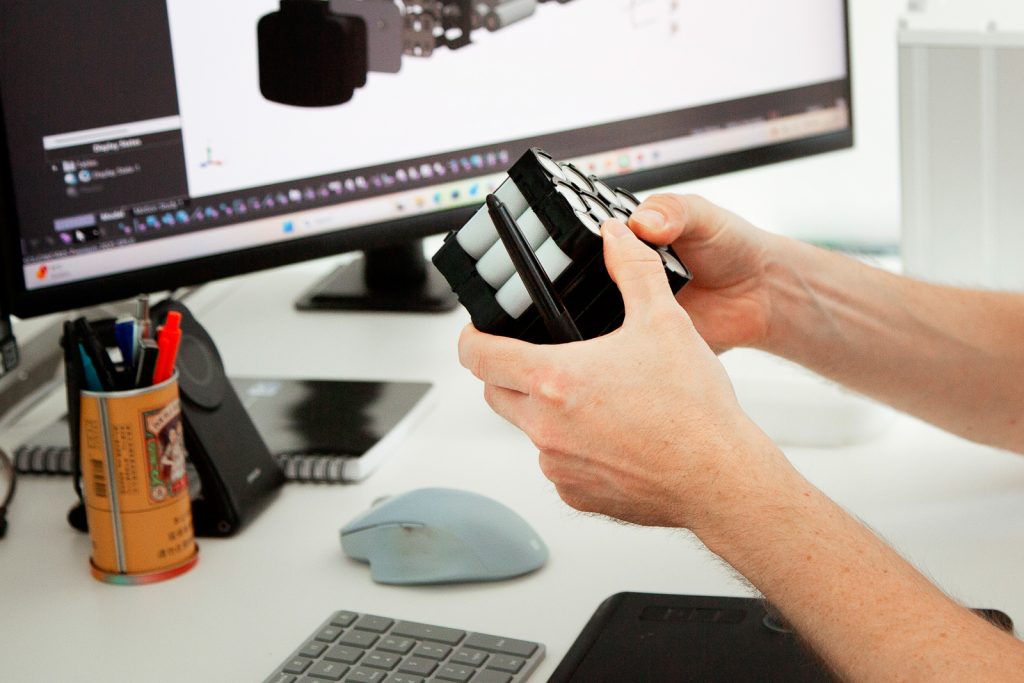
To make it more tangible, Søren compares battery projects to baking with sourdough. A recipe may say four hours, but the dough might be ready earlier or later depending on the flour, the temperature, and the conditions. You have to look at what’s actually in front of you.
“I think projects are like that too,” he says. “You may start with one assumption, but then you have to ask: Does it really have to be this way, or would we end up with a better solution if we did it differently?”
That’s also why improvement is a recurring theme in the way Søren talks about his work. He isn’t driven by doing things the way they were done yesterday. He would rather remove repetitive or unnecessary work altogether.
“I don’t want to be where I was yesterday,” he says. To me, that’s just boring.
At one point, he describes the purpose of his work as “making himself unemployed.” Not because he wants to run out of work, but because he wants to remove tasks that are trivial, inefficient, or unnecessarily complicated. If a problem can be solved so it doesn’t keep coming back, then that’s the better solution.
This mindset reflects something broader about the battery design industry. Customized battery development isn’t simply about buying components and putting them together. It requires the ability to navigate between technical requirements, sourcing, logistics, production methods, customer needs, and real-world limitations.
As Søren puts it, many people may think “it’s just a battery.” But there are many elements that can go wrong along the way.
One of WS Technicals’ strengths is the ability to work within those limitations and still create a solution that makes sense. Not every project has the volume or conditions where everything can be developed from scratch or optimized for mass production. In many industrial projects, the task is to build something robust, functional, and realistic within a specific set of constraints.
That requires technical knowledge. It requires experience. And sometimes, it requires people who think a little differently.
People who ask too many questions. People who unfold the whole problem. People who can see a possible route through a design challenge before the answer is obvious.
At WS Technicals, Søren is one of those people.